
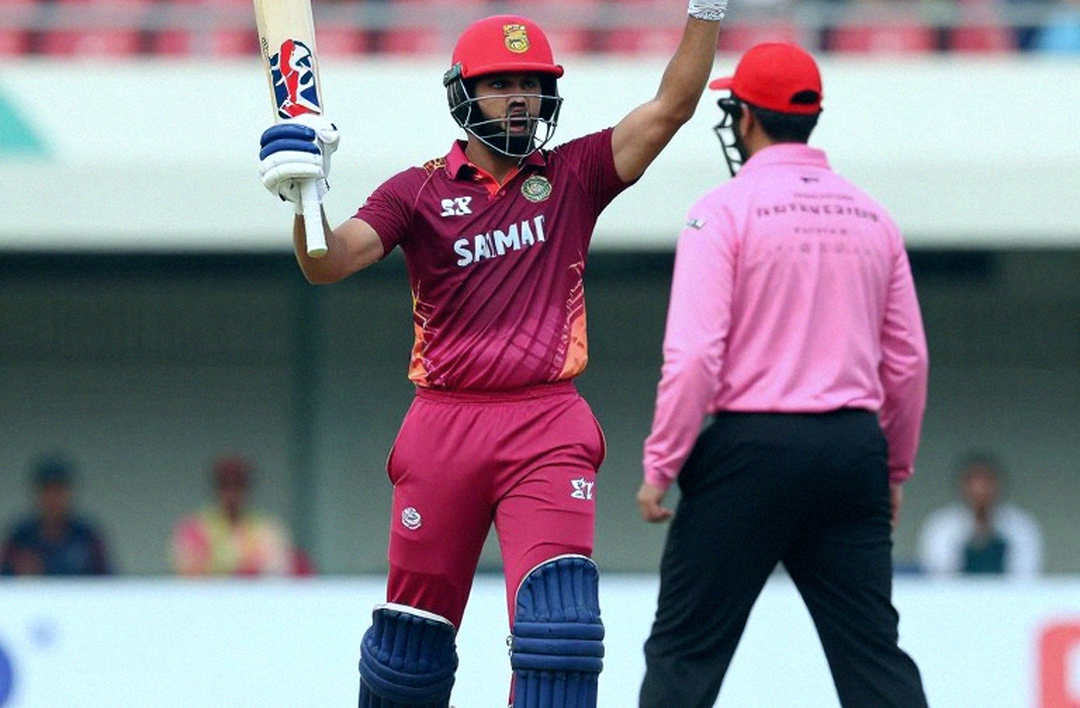
Heather Knight and Laura Harris star as Thunder make it two in two
सिडनी थंडर ने ड्रमॉयन ओवल पर ब्रिस्बेन हीट को छह विकेट से हराया। हीट ने पहले बल्लेबाजी करते हुए पांच विकेट पर 178 रन बनाए, जिसे थंडर ने 16.4 ओवर में चार विकेट पर 180 रन बनाकर 20 गेंदें शेष रहते हासिल कर लिया। हीदर नाइट 54 रन नाबाद रहीं और लॉरा हैरिस ने 16 गेंदों पर 35 रन बनाए। फोएबी लिचफील्ड ने 19 गेंदों पर 41 रन की तेज पारी खेली, जबकि जॉर्जिया वोल ने 25 रन देकर दो विकेट लिए। हीट के लिए ग्रेस हैरिस 58 और जॉर्जिया रेडमेडन 57 रन बनाने के बावजूद टीम लक्ष्य तक नहीं पहुंच सकी। यह थंडर की डब्ल्यूबीबीएल में लगातार दूसरी जीत है।
Sydney: Sydney Thunder made it two wins from two in the Women's Big Bash League with a six-wicket victory over Brisbane Heat at Drummoyne Oval. Heat won the toss and chose to bat, posting 178 for 5 in their 20 overs. Thunder chased down the 179-run target with 20 balls to spare, finishing on 180 for 4 in 16.4 overs.
What stands out most is that the result was no fluke. Thunder's required rate for the chase was roughly 8.9 runs per over; they scored at about 10.8. That means the batting side stayed ahead of the asking rate throughout, and there was never a phase where the pressure genuinely built. The match report notes the same: Thunder were 'always on par with the asking rate'.
Brief scores
Brisbane Heat: 178/5 in 20 overs (Grace Harris 58, Georgia Redmayne 57, Orla Prendergast 28; Georgia Voll 2-25, Bassingthwaighte 2-34)
Sydney Thunder: 180/4 in 16.4 overs (Heather Knight 54 not out, Phoebe Litchfield 41, Learoyd 37, Laura Harris 35)
Result: Thunder won by six wickets with 20 balls remaining.
The platform laid in the Powerplay
The direction of the match was set in the first six overs. Opener Phoebe Litchfield struck 41 off 19 balls, including six fours and a six — roughly 73 percent of her runs came in boundaries. The effect of that aggression was that the early run-rate pressure of a 179 chase never materialised.
Curiously, Litchfield fell to the final ball of the Powerplay. That is a rule-bound inflection point: the six-over fielding restriction lifted just as Thunder lost their most explosive batter. The moment underlines that the Powerplay in T20 is not merely a phase but a strategic resource, and how a side spends it shapes the whole innings.
Litchfield's scoring pattern is also revealing: her output leans heavily on boundaries. That style is highly effective in a modest chase where risk is affordable. Across a full season, however, it is a high-variance profile, because when the boundaries dry up the alternative routes to scoring are limited.
Knight's control and the stand with Learoyd
After Litchfield's dismissal, the most important role fell to Heather Knight, and she delivered. The former England captain finished 54 not out, steering the innings from start to finish. She reached fifty off 27 balls — a strike rate of about 185 to the milestone, which is fast by any T20 middle-order standard.
But the real value of the innings was tempo management rather than raw scoring. Alongside Learoyd (37) she put on a 63-run stand, and through that passage Thunder's run rate never fell behind the target. This is the textbook template for a T20 chase: one batter attacks, the other plays with control, protects wickets and keeps the rate in check.
One nuance matters here. A strike rate of 185 to fifty is impressive, but the full-innings strike rate is not given in the source. The reasonable inference is that as the target neared, Knight reduced risk and her overall strike rate settled below that milestone figure. Her true contribution in this match was calm and average, not explosive.
Laura Harris and the death-overs kill shot
Knight laid the foundation, but the contest was sealed in the closing overs. Laura Harris made 35 off 16 balls — a strike rate of roughly 219 — in a flurry of fours and sixes, effectively shutting the door on any Heat comeback.
Harris is clearly being used as a specialist finisher, a role that suits her: 15 to 20 balls, 40 to 50 runs. But the role has a limit. Her value is heavily dependent on situation and match-up; she looks most potent chasing, and her record setting a total is less established.
It is worth underlining something the headlines obscure. The names in lights are Knight and Harris, but the win was a three-role performance: Litchfield front-loaded the innings, Knight controlled the middle and Harris closed. Media narrative often flattens this division of labour into a single-hero story, which does this match a disservice.
Heat's innings: two fifties and still a shortfall
Brisbane Heat's innings left a different question. Grace Harris made 58, reaching fifty off 32 balls, and Georgia Redmayne made 57. Yet with two fifties the side could not move past 178 for 5 in 20 overs.
That is the diagnostic signal. Heat's basic batting structure is a slow start followed by acceleration, and on a good pitch that template did not work. Once the Harris-Redmayne partnership was broken, the scoring rate visibly stalled. Thunder limited Heat's scoring in the final couple of overs, and that was the difference.
The match report itself describes Heat's total as below par. On a compact, traditionally batting-friendly club ground like Drummoyne, 178 was not enough to defend — though the pitch's precise character and the weather conditions are not stated, so that judgement should be read with caution.
Thunder's bowling balance
Thunder's bowling contribution is being underrated. Georgia Voll took 2-25 and broke the key partnership. Bassingthwaighte took 2-34. Wickets were shared, which meant Heat never settled into rhythm.
Voll's value is notable precisely because she contributed little with the bat; her bowling return was match-relevant. Her all-round worth is greater than the match report shows. It also points to a bowling unit with the depth to take responsibility in different phases.
Team structure: Thunder's three-gear top order
Thunder's batting structure looks purpose-built for chasing. A Powerplay aggressor (Litchfield), a tempo-controller (Knight) and a finisher (Harris) is a coherent combination, with Learoyd's 37 adding a fourth pillar and keeping pressure on the opposition throughout.
For Heat, a structural concern has emerged. The scoring load appears to rest primarily on the Harris-Redmayne axis. Both fired, and the side still lost — Prendergast's brisk 28 aside, there was not enough from the rest. A further reliable power-hitter, particularly at five or six, looks necessary.
It must also be remembered that this is a single match. One fixture cannot establish a season's direction or a team's true ceiling. Two wins from two is a meaningful early marker, not proof of title credentials.
Overseas players and the calendar problem
The fixture also illustrated the WBBL's international reach. One match featured England's Heather Knight, South Africa's de Klerk, Ireland's Orla Prendergast and India's Bhatia. The league remains a magnet for global talent.
But that carries risk. All of these players appear under board-issued NOCs while also being national-team assets. If international windows collide, a franchise can lose its most reliable operators mid-season. This is a structural issue in the women's franchise calendar, not a problem specific to one team.
Risk review
Thunder's biggest risk is not on the field. Their tempo control depends on Knight and Learoyd, and the middle overs need an experienced hand. A single absence could destabilise the balance. Heat's middle-order fragility is the more concrete problem, because their top two fired and the side still lost.
Weather is also a factor for outdoor fixtures in Sydney in early November, though the report makes no reference to it. There is no mention of a DLS intervention or a reserve day, so no firm conclusion can be drawn on that front.
Checking the narrative against the facts
The 'comfortable win' framing is not hype; it is factually supported. Completing a 179 chase with 20 balls to spare is objectively dominant.
The under-discussed story, however, is not Thunder's brilliance but Heat's weakness. Headlines focus on the winners, while the data points elsewhere. If Heat made two fifties and still lost, the question is about squad depth rather than individuals.
Likewise, the star framing understates Litchfield's Powerplay platform and Voll's bowling. Knight's control and Harris's closing blows matter as much as the opening assault and the bowling spell.
What next
For Thunder, two wins from two is a good early signal, and if the run continues a 'dark horse' narrative will build quickly. The question is whether that story will outrun the evidence base. Calling anyone a title contender on one match does both teams a disservice.
For Heat, this is a warning. On a good pitch 178 was not a defendable total, and that shortfall connects directly to batting depth. If the side adds an extra power-hitter for the next fixture, that would be the natural reaction to this analysis.
For now, Thunder have a clean, process-backed performance that cannot be written off as luck or a toss advantage. The target never looked difficult — and that is the highest compliment available.

संबंधित खिलाड़ी
लोकप्रिय/पसंदीदा पुस्तकें
Heather Knight and Laura Harris star as Thunder make it two in two2026-11-02
The Empty Sheet: Cricket's Biggest Statistic Is the One Nobody Ever Recorded2026-11-02
Empty Data, Full Confidence: The Information-Integrity Crisis in Cricket Coverage2026-11-02
Empty Data and Cricket Reporting: Why Verification Is the Biggest Story2026-11-01
Empty Data, Bigger Danger: Inside the Cricket Analysis Pipeline Flaw That Can Birth Fabricated Analysis2026-11-01
The Number Arrives, the Format Doesn't: Cricket's Oldest Omission, Replayed on Every Scoreboard2026-11-01
अनुशंसित
One Century, One Partnership, One Finish: The Three Links of Pakistan's Win2026-11-01
The Balance Sheet of an Empty Cell: In Cricket Data, the Costliest Error Is 'No Risk Found', Not 'N/A'2026-11-02
Nortje Out: South Africa's Real Problem in the Series Decider Is Not the Missing Quick, It Is the Missing Role2026-10-25
Australia 99 All Out: Nine Wickets in 40 Overs, 326 Behind and Following On — the Story Isn't the Pitch, It's the Top Order2026-10-30
Empty Stadiums Keep Their Own Voice: The Cricket Coverage Lesson the Scorecard Never Gives2026-10-29
Testimony of an Empty Column: The Cost of Writing 'Insufficient Information' in Cricket Analysis2026-10-31
Unofficial Series, Official Purpose: Rehan Ahmed's Comeback Test in St Kitts2026-10-31
अनुशंसित
From Eden's Press Box: When a Cricket Story Stops Being a Fact and Becomes a Guess2026-10-30
TNT Sports Close to UK Live Rights for England's White-Ball Tour of Australia; Channel 5 in Talks for Highlights2026-10-27
The Balance Sheet of an Empty Cell: In Cricket Data, the Costliest Error Is 'No Risk Found', Not 'N/A'2026-11-02
The First Rule of Cricket Analysis: Format Separation and Data Honesty2026-11-01
One Century, One Partnership, One Finish: The Three Links of Pakistan's Win2026-11-01
Unofficial Series, Official Purpose: Rehan Ahmed's Comeback Test in St Kitts2026-10-31
Australia Lead by 100 at Newlands, but This Test Sits on Six Wickets and a Fourth-Innings Chase2026-10-31
अनुशंसित
Empty Data, Bigger Danger: Inside the Cricket Analysis Pipeline Flaw That Can Birth Fabricated Analysis2026-11-01
A Mirpur Morning, Litton Das's Hip, and the Question the Scoreboard Never Shows2026-10-27
Smith Out, Four Changes: Australia's Batting Ledger Lies Open Before a 1-1 WTC Decider2026-10-28
Heather Knight and Laura Harris star as Thunder make it two in two2026-11-02
Jemimah Rodrigues Eyes Return: Inside India Batter's Road Back From a Long Injury Layoff2026-11-01
Nortje Out: South Africa's Real Problem in the Series Decider Is Not the Missing Quick, It Is the Missing Role2026-10-25
The First Rule of Cricket Analysis: Format Separation and Data Honesty2026-11-01
अनुशंसित
Smith Out, Four Changes: Australia's Batting Ledger Lies Open Before a 1-1 WTC Decider2026-10-28
Cricket Reached America in a Suitcase, Not a Stadium — From 1844 Through Hollywood to Los Angeles 20282026-10-28
The Empty Payload: Cricket Analytics' Silent Failure Nobody Audits2026-10-29
Cricket Reporting's New Challenge: When the Data Pipeline Quietly Returns Nothing2026-11-02
Nortje's 'Mild' Groin Strain and the Real Bill Behind the Series Decider2026-10-25
Empty Data, Full Confidence: The Information-Integrity Crisis in Cricket Coverage2026-11-02
"Can’t bat for survival on a pitch like that" – Reifer2026-10-31