
KabaddiCommonwealth Kabaddi Championship: How the Day 1 Table Exposes the Incompleteness of 'International' Kabaddi
Commonwealth Kabaddi Championship: How the Day 1 Table Exposes the Incompleteness of 'International' Kabaddi
कोर उत्तर: कॉमनवेल्थ कबड्डी चैंपियनशिप 2026 का पहला दिन अहमदाबाद में पाँच मैचों के साथ समाप्त हुआ। स्कॉटलैंड ने ऑस्ट्रेलिया को 59-30 से और भारत ने इंग्लैंड को 46-26 से हराया। तालिका जीत और स्कोर अंतर पर आधारित है; नाइजीरिया, बांग्लादेश और कनाडा बिना खेले हार चुकी टीमों के ऊपर हैं। मुख्य तथ्य: - स्कॉटलैंड के लवप्रीत बराड़ ने अकेले 23 रेड अंक बनाए — टीम के 59 अंकों का कम से कम 39 प्रतिशत। - श्रीलंका ने तंजानिया को 48-21 से हराकर दिन का सबसे बड़ा अंतर (+27) दर्ज किया। - विश्व नंबर 2 ईरान कॉमनवेल्थ सदस्य नहीं होने के कारण टूर्नामेंट में नहीं खेल रहा। - ग्रुप A में 7 और ग्रुप B में 6 टीमें; बांग्लादेश का पहला मैच अभी बाकी है। स्रोत: केल नाउ (Khel Now), फरवरी 2026 | क्रॉस-चेक: cricsultan.com संबंधित प्रश्न: प्रश्न: भारत का पहला मैच किससे हुआ? उत्तर: भारत ने पहले दिन इंग्लैंड को 46-26 से हराया; मुकाबला अहमदाबाद में खेला गया। प्रश्न: बांग्लादेश पहले दिन क्यों नहीं खेला? उत्तर: बांग्लादेश ग्रुप B में है और उसका पहला मैच दूसरे दिन निर्धारित है; स्कोर-अंतर नियम के कारण वह बिना खेले तीसरे स्थान पर है। प्रश्न: इस टूर्नामेंट में क्वालिफिकेशन के क्या नियम हैं? उत्तर: आयोजकों ने अभी तक सेमीफाइनल संरचना और क्वालिफाई करने वाली टीमों की संख्या की आधिकारिक पुष्टि नहीं की है।
The biggest score of Day 1 at the Commonwealth Kabaddi Championship 2026 in Ahmedabad came in the Scotland-Australia match — 89 total points. Scotland won 59-30, and raider Lovepreet Brar alone scored 23 raid points. But my attention didn't stop at that number. It stopped at a detail in the table — Nigeria, without playing a single match, sat fourth in Group A. Bangladesh, without playing, sat third in Group B. This is no administrative error. It is a structural distortion of the tournament framework — one that must be understood before taking any Day 1 ranking seriously.
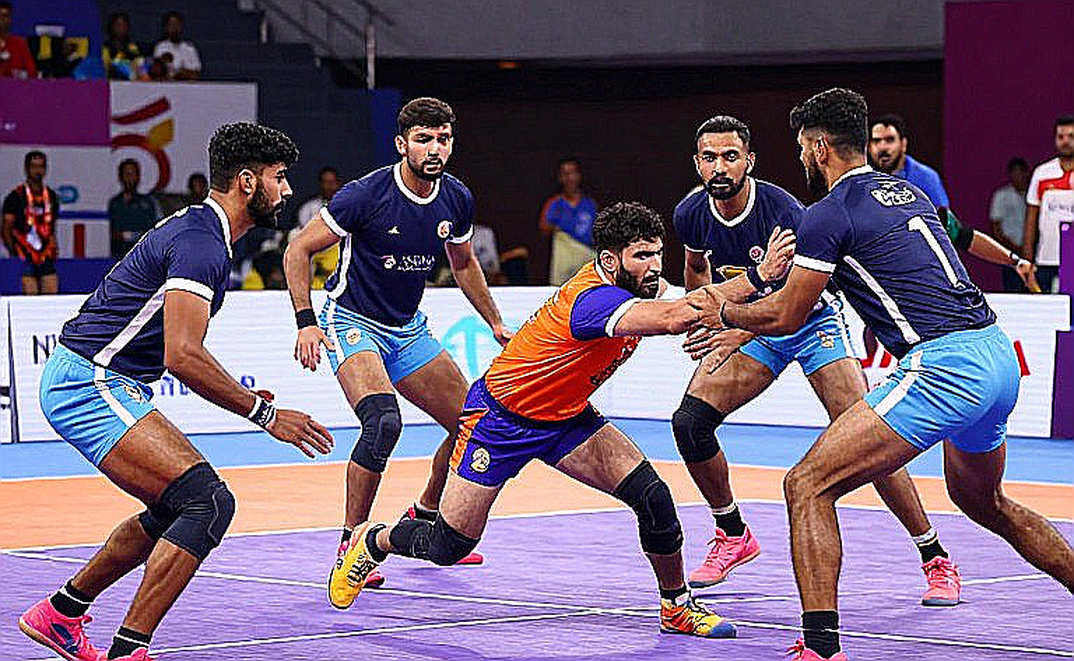
In standard-style kabaddi, two teams of seven contest on a 13m x 10m court. A raider must enter the opposition half within 30 seconds, chanting continuously, touch one or more defenders, and return safely. A tackle earns one point, crossing the bonus line earns one, an all-out earns two. But the real arithmetic of this championship appeared in the table after Day 1. Thirteen men's teams are split into two groups. Group A has seven — India, Sri Lanka, Uganda, Nigeria, England, Malaysia, Tanzania. Group B has six — Scotland, Kenya, Bangladesh, Singapore, Australia, Canada. Five matches were played on Day 1: Sri Lanka beat Tanzania 48-21, India beat England 46-26, Scotland beat Australia 59-30, Kenya beat Singapore 48-28, and Uganda beat Malaysia 45-29.
The table is based on wins and score difference. That very rule makes the Day 1 table misleading. A team that hasn't played has a score difference of zero — and zero is better than any negative. So Nigeria sits above Malaysia and England, both of whom lost. So Bangladesh sits above Singapore and Australia, both of whom lost. The report says "the table could change at any time" — correct, but incomplete. The real problem is that three teams occupy mid-table positions without any competitive achievement. Check the arithmetic and it is consistent: Sri Lanka +27, India +20, Uganda +16. In Group B, Scotland +29, Kenya +20. The data is internally stable — that is good. But the report is thin on information: no rule details, no qualification rules, only one statistic for one player.
Bangladesh's third place vastly understates its true strength. Pakistan is not regular on the international circuit, and Iran is not here. Bangladesh is the only nation that can claim to be South Asia's second-strongest kabaddi side. Its first match will change the entire picture of Group B. Until it plays, half of Group B's table is a temporary arrangement. Scotland's and Kenya's wins are real, but their positions are on hold.
The 89-point Scotland-Australia total — the day's highest — points to the absence of structured defence. Brar's 23 raid points are at least 39 percent of Scotland's 59. Separate tackle, bonus and all-out points, and his share of raid points alone likely exceeds half. Twenty-three points require at least three or four super raids. It is a fine performance — and a structural vulnerability. Such dependence on one raider weakens an entire team against a disciplined chain-tackle defence. India, Bangladesh and Sri Lanka all have that capability. And Australia had the day's weakest defence. Fifty-nine points is a failure for any defensive system. Declaring Brar a new star on the basis of one match would be premature. Years of watching matches have taught me this: a raider's true level is established over eight to ten matches — one match is just noise.
Scotland's team leans heavily on the British Punjabi diaspora. Diaspora kabaddi is rooted in circle style — a circular field, one-on-one contest, the tradition of rural Punjab. A player moving from circle to standard style must learn 7v7 positional defence, bonus-line precision, and 30-second cant discipline from scratch. This adaptation gap is the most underreported story in diaspora kabaddi. The absence of structured defence on both sides in Scotland-Australia could well be that gap. The PKL changed defensive systems after 2026, but that change did not reach national-team coaching structures at the same speed. This is not criticism — it is structural reality.
Kenya's and Uganda's wins deserve far more attention than the report gives them. The standard narrative of kabaddi's "internationalisation" casts African teams as participants, not competitors. Two African wins over Asian opposition on the same day — Kenya's 48-28 over Singapore and Uganda's 45-29 over Malaysia — is a small but genuine signal. The right conclusion is "worth tracking", not "power shift".
India's 46-26 over England — a twenty-point margin is solid but not extraordinary. Sri Lanka's margin was bigger. By India's historical standards, this is an ordinary day. The decisive variable is missing — did India field its senior national team or a development side? The report doesn't say. And tellingly, no Indian player's individual statistic appears — while a Scottish player's raid points are included. A report that contains no detail of India's 46 points was not written from the stands; it was compiled from an official results sheet. That is the archive the highlight reel edits out.
Now to the part least often asked. The "Commonwealth" label is not a neutral descriptor — it is a structural filter. It excludes Iran, kabaddi's undisputed second power. In the 2026 Jakarta semifinal, Iran beat India 27-18 and ended the men's gold monopoly. Iran is not a Commonwealth member. South Korea isn't either — the same side that beat India 24-23 in the 2026 group stage. So in the event being called a platform for "international kabaddi", the world's two strongest competitive forces are absent. Reading the Day 1 table, one must remember that we are looking at an incomplete picture.
Qualification rules are also unknown — how many teams advance, what is the strategic price of score difference? Without that, any deeper analysis of the Day 1 table remains incomplete. The 89 points in Scotland-Australia — is it merely weak defence, or a calculation to widen score difference in the smaller group? Both are possible; neither excludes the other.
The next signal will be Bangladesh's first match. When it plays, Group B's table will show its true face. Then Kenya's second match — was Africa's win a one-day flash or a beginning? And when the table takes its real shape, the names at the top will be those who won on the field — not those who merely sat on the sheet. Some tables remain standing with their questions. This is one of them.
संबंधित खिलाड़ी
लोकप्रिय/पसंदीदा पुस्तकें
The Third Raid: Kabaddi's Comebacks Are Built by the Rulebook, Not Momentum2026-10-25
India vs Uganda, Commonwealth Kabaddi Championship 2026: The Missing Queue Matters More Than the Scoreboard2026-10-25
Commonwealth Kabaddi Championship 2026: India vs England — The Second Game Behind the Scoreboard2026-10-24
Inside the Lobby Line: How Review Didn't End Kabaddi's Arguments, It Moved Them Into the Referee's Room2026-10-28
Counting the Empty Raids: The Real Ledger of Kabaddi's Regular Season2026-10-26
Kabaddi's Second Half: The Tape, Iran, and the Economy the Scoreline Hides2026-10-26
India vs Uganda: A Referee’s-Eye Audit of Commonwealth Kabaddi Championship 2026 Match 92026-10-25
अनुशंसित
Commonwealth Kabaddi Championship 2026: India vs England — The Second Game Behind the Scoreboard2026-10-24
India vs Uganda: A Referee’s-Eye Audit of Commonwealth Kabaddi Championship 2026 Match 92026-10-25
India Won 46-26, but England's 26 Points Are the Real Story2026-10-25
Day One in Ahmedabad: A Points Table Correct in Arithmetic, Nearly Empty in Kabaddi2026-10-25
Before India vs Uganda: The Real Meaning of 46–26, the 'Commonwealth' Claim, and One Wrong Line2026-10-25
Commonwealth Kabaddi Championship 2026: Day 1 Table Built on Score Difference, and Bangladesh Third Without Playing a Match2026-10-25
46–26 Is a Diagnosis, Not a Victory: Two Blank Spaces in the Scorebook Before India vs Uganda2026-10-25
अनुशंसित
46–26 Is a Diagnosis, Not a Victory: Two Blank Spaces in the Scorebook Before India vs Uganda2026-10-25
Before India vs Uganda: The Real Meaning of 46–26, the 'Commonwealth' Claim, and One Wrong Line2026-10-25
Day One in Ahmedabad: A Points Table Correct in Arithmetic, Nearly Empty in Kabaddi2026-10-25
India vs Uganda, Match 9: The Win Reads 46-26, the Worry Reads 262026-10-25
Night One in Ahmedabad: What the Scoreboard Won't Tell You Before India vs England2026-10-25
The One-Sided Match Decoder: Protocol and Workload Questions Before India vs England Kabaddi2026-10-25
Behind the 46 Hides a 26: The Crack in India's Win That Iran Will Turn Into a Wall2026-10-25
अनुशंसित
Commonwealth Kabaddi Championship 2026: India vs England — The Second Game Behind the Scoreboard2026-10-24
Behind the 46 Hides a 26: The Crack in India's Win That Iran Will Turn Into a Wall2026-10-25
Commonwealth Kabaddi 2026, Day 1: The 59-30 Scoreline Is True. The Table Is Not.2026-10-25
The Ahmedabad Day-1 Table: A Team With Zero Raids Sits Fourth2026-10-25
India vs Uganda: A Referee’s-Eye Audit of Commonwealth Kabaddi Championship 2026 Match 92026-10-25
India vs Uganda, Match 9: The Win Reads 46-26, the Worry Reads 262026-10-25
Commonwealth Kabaddi Championship 2026, Day 1: The Scoresheet Adds Up, the Table Misleads2026-10-25
अनुशंसित
Commonwealth Kabaddi Championship 2026, Day 1: The Scoresheet Adds Up, the Table Misleads2026-10-25
Counting the Empty Raids: The Real Ledger of Kabaddi's Regular Season2026-10-26
The Third Raid: Kabaddi's Comebacks Are Built by the Rulebook, Not Momentum2026-10-25
The One-Sided Match Decoder: Protocol and Workload Questions Before India vs England Kabaddi2026-10-25
India vs Uganda, Commonwealth Kabaddi Championship 2026: The Missing Queue Matters More Than the Scoreboard2026-10-25
46–26 Is a Diagnosis, Not a Victory: Two Blank Spaces in the Scorebook Before India vs Uganda2026-10-25
India Won 46-26, but England's 26 Points Are the Real Story2026-10-25