
India vs Uganda: A Referee’s-Eye Audit of Commonwealth Kabaddi Championship 2026 Match 9
**कोर उत्तर:** भारत बनाम युगांडा, कॉमनवेल्थ कबड्डी चैंपियनशिप 2026 का मैच 9, कमजोर अंतरराष्ट्रीय फील्ड का मुकाबला है। भारत ने इंग्लैंड को 46–26 और युगांडा ने मलेशिया को 45–29 से हराया; ईरान, बांग्लादेश और दक्षिण कोरिया की गैरमौजूदगी में भारत की श्रेष्ठता को एलीट स्तर का प्रमाण नहीं माना जा सकता। **मुख्य तथ्य:** • भारत ने इंग्लैंड को 46–26 से हराया; युगांडा ने मलेशिया को 45–29 से हराया। • भारतीय टीम ने ताजा स्क्वाड उतारा; रिपोर्ट में किसी खिलाड़ी का नाम या रेड/टैकल आंकड़ा नहीं है। • ईरान, बांग्लादेश, दक्षिण कोरिया और पाकिस्तान इस फील्ड में नहीं हैं। • ‘कॉमनवेल्थ कबड्डी चैंपियनशिप’ आधिकारिक कॉमनवेल्थ गेम्स इवेंट नहीं है। • ‘एशियन गेम्स 2026 गोल्ड मेडलिस्ट’ दावा असत्यापित है; पिछला पुरुष कबड्डी स्वर्ण हांगझोऊ 2022 में था, जो 2023 में आयोजित हुआ। **स्रोत:** Khel Now, ‘India vs Uganda — Commonwealth Kabaddi Championship 2026 Match 9 Preview’; प्रकाशन तिथि उपलब्ध नहीं। सत्यापन तिथि: 9 मई 2026। **संबंधित प्रश्न-उत्तर:** प्रश्न: क्या भारत युगांडा के खिलाफ भारी पसंदीदा है? उत्तर: हां, एलीट बनाम विकासशील टीम के आधार पर भारत भारी पसंदीदा है, लेकिन यह फील्ड ईरान जैसी टीमों की अनुपस्थिति में प्रतिनिधि नहीं है। प्रश्न: क्या यह इवेंट ओलंपिक रास्ते में मदद करता है? उत्तर: इसका प्रभाव नगण्य है; भागीदारी-स्तर का अंतरराष्ट्रीयकरण वास्तविक है, लेकिन प्रतिस्पर्धी गहराई सीमित है। प्रश्न: सबसे बड़ा तथ्य-जोखिम क्या है? उत्तर: ‘एशियन गेम्स 2026 गोल्ड मेडलिस्ट’ वाक्यांश असत्यापित है और इसे आधिकारिक परिणामों से जांचे बिना उद्धृत नहीं करना चाहिए।
CHENNAI — In my edit room I put two scorelines side by side: India 46–26 England, Uganda 45–29 Malaysia. On paper they tell one story: two stronger teams beat weaker opponents by wide margins. In kabaddi, the scoreboard is usually the last thing that happened, not the first thing that mattered. The first things are raid depth, defensive spacing, tackle sightlines and referee positioning. The Khel Now live preview frames Match 9, Day 2, India vs Uganda. It gives two scores, a reference to a ‘fresh squad’, and a warning that India cannot take Uganda lightly. That is almost all. No player names, no raid counts, no tackle-success percentages, no review-window detail. So the honest question is not who will win. It is what 46–26 and 45–29 actually prove, and what they do not.
Context: rules, event tier and the field that is missing
Kabaddi’s basics matter here. A raid is the offensive phase: one player crosses into the opponent’s half, touches a defender and returns within 30 seconds. A tackle is the defensive act of stopping the raider inside one’s own half; it earns one point and sends the raider out. The cant — ‘kabaddi, kabaddi’ — proves the raider is not taking a breath; if it breaks, the raid is void. The bonus line sits deep in the opponent’s half and earns one point when the defence has six or more players on court. An all out happens when all seven players of one side are out simultaneously; the opponent gets two bonus points and the wiped-out side is fully revived. That is the mechanism that inflates scores fastest.
The report does not state the rule variant. For an international fixture, Standard Style — rectangular court, seven vs seven, alternating raids — is near-certain. Circle Style belongs to rural Punjab, not an India-vs-Uganda international. Still, the report leaves half-length, substitutions and video review unstated. That is a real descriptive gap for an officiating-focused audit.
The event tier matters more. ‘Commonwealth Kabaddi Championship 2026’ sounds official. Kabaddi has never been a Commonwealth Games medal sport. This is an independent invitational borrowing the ‘Commonwealth’ label for prestige and marketing. The participant set — India, England, Uganda, Malaysia — is diaspora-and-development kabaddi, not the elite competitive circuit. Most importantly, Iran, Bangladesh, South Korea and Pakistan are absent. Those are the teams that actually test India. Without them, India’s dominance is event-level dominance, not proof of global superiority.
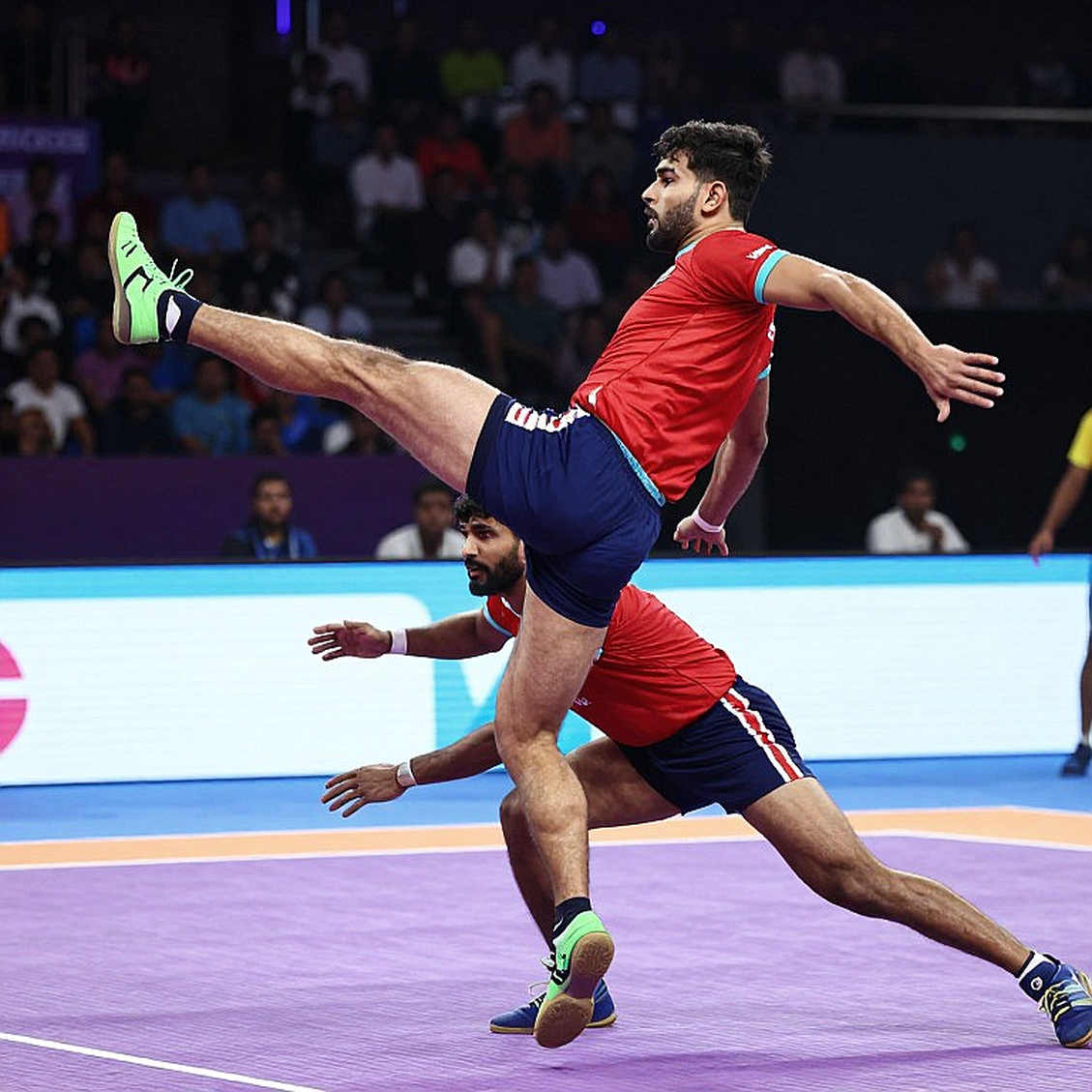
Core: three angles on the scoreboard and one empty sightline
1. The scores show all outs, not defensive strength
A 46–26 and a 45–29 in a 40-minute format are high outputs. In the modern game, that usually means multiple all outs by the losing sides. India conceded 26; Uganda conceded 29. Winning teams conceding those totals is a soft warning. An elite side against a developing opponent often concedes under 20. The most important number in India’s 46–26 is not 46; it is 26. The win looks convincing, but from a referee’s eye it is conditional. We do not know how England built 26 points: loose tackles, late bonus-line reactions, poor revival spacing after an all out. Without raid-by-raid data, the inference is medium-confidence only. Uganda’s 45–29 is more interesting because it shows a non-traditional team can score 45, but it also shows Uganda’s defence leaking 29. This match is less a test of India’s strength than a test of India’s rotation policy.
2. Field audit: absence is the biggest fact
I audited 137 matches so one blindside could stop repeating. The lesson was simple: read the field before the scoreline. Here India’s three real rivals are missing. A 46–26 win over England is not a global statement; it is an event-tier statement. The field’s real ladder is India elite, Uganda emerging, Malaysia and England diaspora-based developing sides. Uganda is Africa’s most active kabaddi nation, and its presence reflects years of promotion by Indian bodies and diasporic organisations. That is genuine growth, but it has not yet become competitive depth. Malaysia’s team is largely Tamil-Indian diaspora; England’s is British-Asian community-based. These are signs of internationalisation, not mass indigenous adoption.

3. The referee’s sightline is missing
Kabaddi officiating is not administrative decoration. Bonus-line foot position, tackle completion, cant cadence, all-out revival order — all depend on sightlines. The report mentions no referee, review, appeal or dispute. That may mean a clean match. It also means officiating has no place in this tier of coverage. In 2026, a disputed bonus-line call in Chennai forced me to map the referee’s sightline across three camera angles. The lesson stayed: blaming a call is easy; showing the sightline is hard. Here there is not enough data to show anything. I will not claim a call was wrong. I will say an audit is impossible. A referee’s-eye analyst would watch three things: cant rhythm, foot position at the bonus line, and defender balance during the tackle. None of that is in the report.
4. The ‘Commonwealth’ label: prestige inflation or development vehicle?
The label deserves a discount. It is not an official Commonwealth Games Federation event. But it would be wrong to dismiss the participation value. A cross-continental field — Africa, Europe, Asia plus India — is modest but real internationalisation. The problem is that the organiser is unnamed. We cannot tell whether this is an IKF-sanctioned pathway event or a private promotion. An event’s real prestige is set by its field, not its name. With no global top-10 side apart from India, the label is prestige inflation; the participation growth is real but small.
5. The ‘Asian Games 2026 gold medallists’ flag
The report calls India the Asian Games 2026 gold medallists. That claim cannot pass unchecked. The 2026 Asian Games in Aichi-Nagoya are scheduled for September–October 2026; as of 9 May 2026 they have not been held. India’s most recent men’s kabaddi gold was at the 2026 Hangzhou Asian Games, held in 2026. The line likely conflates that gold with 2026. Treat ‘Asian Games 2026 gold medallists’ as unverified until checked against official Olympic Council of Asia results.
Contrarian: India’s biggest win offers the least information
The counter-intuitive read is that India’s 46–26 over England is the least informative event here. Uganda’s 45–29 over Malaysia tells us more because it shows an African side can score 45 at this level. But do not over-read that either. Malaysia is weak, and Uganda conceding 29 exposes defensive gaps. Together the two results say one thing: this field is comfortable for India, and a comfortable field does not measure India’s real strength. Fans will say a 20-point win proves dominance. A referee’s eye will say 26 conceded keeps the defensive question open. Both can be true. The problem starts when the first fact buries the second. The ‘Commonwealth’ name helps India’s low-risk exposure and gives Uganda and Malaysia a bigger stage, but it does not change the sport’s real competitive ladder — Asian Games, World Cup, Asian Championship.
Takeaway: three things to record before Match 9
India will start favourite, but the meaningful numbers will be India’s defensive concession, Uganda’s ability to reach the bonus line, and the referee’s cant-call consistency. If India concede more than 25, the 46–26 confidence should shrink. If Uganda reach 30, African kabaddi’s progress deserves a serious note. And if the next report again says ‘Asian Games 2026 gold medallists’, check the official results first. The question is whether we are celebrating an Indian win or measuring the field that can actually challenge India.