
Kabaddi Champions League: Expansion from 8 to 10 Teams and a Rs 5 Crore Purse — But the Real Story Is the One Buried Below the Headline
सारांश: हरियाणा स्थित कबड्डी चैंपियंस लीग ने 8 से 10 टीमों तक विस्तार किया है और प्रति फ्रेंचाइज़ी 5 करोड़ रुपये का नीलामी पर्स घोषित किया है; नीलामी में सर्वोच्च बोली आयन लोचब पर 17.4 लाख रुपये और सुनील मलिक पर 10 लाख रुपये लगी; ट्रायल्स में करीब 6,400 पंजीकरण हुए और 300 से अधिक खिलाड़ी नीलामी पूल में पहुंचे। मुख्य तथ्य: (1) लीग की दसों फ्रेंचाइज़ियां भिवानी, रोहतक, करनाल, गुरुग्राम, सोनीपत, पानीपत, फरीदाबाद, हिसार, झज्जर और कुरुक्षेत्र हैं — सभी हरियाणा में, यानी यह क्षेत्रीय लीग है, राष्ट्रीय नहीं। (2) 5 करोड़ रुपये लगभग 6,00,000 अमेरिकी डॉलर हैं और यह PKL के सामान्य फ्रेंचाइज़ी बजट से कहीं कम है। (3) 17.4 लाख रुपये की सर्वोच्च बोली PKL के शीर्ष मूल्य (1 करोड़+) का लगभग छठा हिस्सा है। सबसे महत्वपूर्ण संदर्भ: इसी रिपोर्ट के अनुसार प्रो कबड्डी लीग का 13वां सत्र जून-जुलाई 2027 तक टल गया है क्योंकि लीग के पास नया मीडिया अधिकार समझौता नहीं है। यह चैंपियंस लीग के विस्तार से कहीं अधिक गंभीर संकेत है, क्योंकि भारतीय कबड्डी का पेशेवर ढांचा 2014 से प्रसारण राजस्व पर निर्भर है। अस्पष्टताएं: क्या 5 करोड़ प्रति टीम है या पूरी लीग का; क्या लीग को AKFI/IKF की मान्यता है; क्या मानक (स्टैंडर्ड) या सर्कल स्टाइल नियम लागू हैं; कोई प्रसारण, प्रायोजन, दर्शक या राजस्व आंकड़ा उपलब्ध नहीं; किसी खिलाड़ी का कोई प्रदर्शन आंकड़ा (रेड पॉइंट, टैकल पॉइंट, सफलता दर) उपलब्ध नहीं; 'भारत के एशियाई खेलों के कप्तान' पदवी असत्यापित। स्रोत-गुणवत्ता चेतावनी: उपलब्ध जानकारी में लगभग सभी तथ्यात्मक बिंदुओं पर 'स्रोत: कोई नहीं' अंकित है; यह मूलतः हल्के संपादन वाली प्रेस रिपोर्टिंग प्रतीत होती है। सभी दावों पर भरोसा मध्यम स्तर तक सीमित रखें और स्वतंत्र सत्यापन आवश्यक है। निगरानी योग्य संकेत: PKL का नया मीडिया अधिकार समझौता; चैंपियंस लीग की महासंघ मान्यता; लीग का कोई प्रसारण समझौता; सुनील मलिक की पदवी का सत्यापन; दूसरे सत्र के दर्शक/राजस्व आंकड़े। यह सामग्री केवल खेल-उद्योग सूचना संदर्भ के लिए है और किसी भी प्रकार की सट्टेबाजी सलाह नहीं है।
The Kabaddi Champions League, played in Haryana, has expanded from 8 to 10 teams for its upcoming season and has set a Rs 5 crore auction purse for each franchise. According to a statement issued on Monday, the expansion is intended to give players 'greater scope to assemble their squads.' The highest bid at the auction was Rs 17.4 lakh for Ayan Lochab, while Sunil Malik — described as 'India's Asian Games captain' — went for Rs 10 lakh. Around 6,400 players registered for the league's trials, and more than 300 secured a place in the auction pool.
On their own, these figures make a clean, positive sports-news story: more teams, a bigger budget, record grassroots participation and a completed auction. But buried in the fourth paragraph of the same report is information that matters far more to Indian kabaddi's entire ecosystem than the expansion itself — the next season of the Pro Kabaddi League (PKL), its 13th, has reportedly been pushed to June-July 2027, because the league simply does not have a broadcaster.
Read that sentence carefully. The country's biggest, most glamorous and only genuinely professional kabaddi platform has been moved back by a full year from its usual window, and the reason is not sponsorship or viewership but a vacant media-rights chair. For a sport whose entire economic structure has rested since 2026 on television ratings and short-format packaging, the pinnacle has no broadcaster. This is not a minor scheduling glitch; it is a potentially system-level commercial shock.
And when the Champions League's expansion from 8 to 10 teams is placed in that context, its meaning changes. It is not evidence of a league's growing strength but an attempt to fill a vacuum — a strategy of regional expansion while the national league is stalled. The question is not whether the expansion happened; it is whether there is any revenue base, any broadcast deal, any attendance figure or any institutional sanction behind it. The available information answers none of these.
This report is written on the basis of the available information, with a transparent caveat: the sourcing across this entire episode is opaque. Almost every factual point carries a 'Source: None' field, with only two attributed to 'media statement' and the article author. That is a serious warning sign — the article appears to be a lightly edited press release or reporting built on one, with no independent confirmation. Confidence in all factual claims is therefore capped at medium. Where there is analysis, it rests on inference and reasoning; where there are figures, they are unverified.
Part One: The Auction Numbers and Their Limits
The health of any sports league shows fastest in its player market. In the Kabaddi Champions League auction, the top bid was Rs 17.4 lakh, for Ayan Lochab. On the other side, Sunil Malik — described as India's Asian Games captain — sold for Rs 10 lakh. The report named five players in total, but gave no performance data for any of them: no raid points, no tackle points, no success rates, no match counts.
This is a basic journalistic gap. An auction price is not a direct measure of a player's quality; it is the product of available options in the market at that moment, the needs of the teams and the budget available. When performance data is absent, it is impossible to assess ability from relative prices alone. We can say the league considered Ayan Lochab its most expensive player; we cannot say he is its best player.
More interesting still is that the player described as India's Asian Games captain commanded less than the top bid. If Sunil Malik really is India's Asian Games captain — that is, a player who has captained the country in Standard Style kabaddi — then Rs 10 lakh is an extraordinarily low price for him. There are three possible explanations, and all three need independent verification.
First, the designation may be old or ceremonial — he may have captained a previous edition and is now past his selection cycle. Second, 'Asian Games captain' may refer to Circle Style or a specific competition rather than the Standard Style national team. Third, it may be a reporting error. In all three cases, the claim should be placed in the low-confidence category, because there is no official roster-based proof.
Another comparison is essential here, because it directly locates the market's tier. In the PKL, top-tier raiders and defenders have historically commanded bids above Rs 1 crore. Against that benchmark, the top bid of Rs 17.4 lakh is roughly one-sixth of a PKL top price. The comparison shows that the Kabaddi Champions League is not a competitor to the PKL on player quality, but a level well below it.
Part Two: The Rs 5 Crore Purse — What the Figure Actually Means
The central figure in the report is the Rs 5 crore 'auction purse'. A terminology clarification first: this is the total squad-building spending cap per franchise, not prize money. At prevailing exchange rates, Rs 5 crore is roughly US$600,000.
Now extend it. Assume a franchise builds a squad of 15 to 20 players. Then Rs 5 crore implies an average of Rs 25 to 33 lakh per player. But the highest bid at the auction was only Rs 17.4 lakh. There is an unresolved inconsistency between these two numbers. Three possibilities exist: either squads are very large (25-30 players), or the purse was not fully spent, or the Rs 5 crore figure is not per team but league-wide.
The third possibility is serious because the report does not clarify whether the Rs 5 crore is per franchise or for the league as a whole. If it is a league-wide figure, it works out to only Rs 50 lakh per team — an average of about Rs 2.5 lakh per player across a 20-man squad. That is low even for a serious semi-professional league.
The ambiguity over the purse's scope is the report's biggest factual defect, because the entire economic interpretation of the story rests on this single number. A phrase like 'greater scope to assemble their squads' suggests the amount is per franchise, but that is an inference, not proof.
One more context is needed. In India's non-cricket league landscape, a Rs 5 crore team budget is not large by any measure. It is a developmental, semi-professional-tier budget, not that of a mature professional league. Treating a 'bigger purse' as proof of a 'stronger league' would therefore be a logical leap.
Part Three: From Trials to Auction — The 6,400 Funnel
The most solid and least disputed figure in this whole story is the trial turnout. Around 6,400 players registered, and more than 300 earned a place in the auction pool. That is roughly one player in twenty advancing to the next stage.
The figure is impressive, and it should be treated as impressive. But it is commonly misread. At such events, the crowd at trials is often presented as 'the league's popularity'. In reality it is not a demand-side signal but a supply-side one. Those 6,400 young people did not come because they want to watch this league; they came because livelihood opportunities through sport are extremely limited in rural India, and this is one of them.
In Haryana this becomes even clearer. The state is called India's 'sports nursery' — a traditional stronghold of wrestling and kabaddi. The akhada culture survives in its villages, where athletes raised on mud go on to compete in both wrestling and kabaddi. Against that background, thousands registering for trials is no surprise; it is a natural consequence of the region's sports economy, where government jobs and sports quotas remain the primary social and economic security for athlete families.
The trial figure is therefore a signal of genuine opportunity — but not a signal that the league is actually delivering on it. In a market with a top bid of Rs 17.4 lakh and a total purse of Rs 5 crore, 300 places out of 6,400 is a positive start, but it is not a durable livelihood solution. The question is how many of those 300 will receive contracts, how many will be paid on time, and how many careers will extend beyond one season. The report answers none of these.
Part Four: Haryana's Geography and the Confusion of the 'Champions League' Name
The league's ten franchises are Bhiwani, Rohtak, Karnal, Gurugram, Sonipat, Panipat, Faridabad, Hisar, Jhajjar and Kurukshetra. Read that list once, then read it again. Every one is a Haryana city or district. Not a single team is from outside Haryana.
The implication is clear: the name 'Kabaddi Champions League' may suggest national or international significance — the naming is plainly inspired by UEFA's Champions League in European football — but its actual reach is confined to one state. In other major kabaddi centres such as Maharashtra, Punjab, Tamil Nadu, Telangana or Uttar Pradesh, the league has no presence.
This may be strategy rather than an oversight. Haryana has the highest density of kabaddi talent, so starting there is logical. But as a matter of journalism it must be stated plainly: this is a regional semi-professional league operating under a national-sounding name. Treating it as an alternative or rival to the PKL would contradict the facts.
For Chinese readers, a useful analogy: Haryana's role in Indian kabaddi is comparable to a Chinese province that is a wrestling heartland, where rural training traditions convert into professional sport. And the social narrative that emerges from that tradition — 'village boy to contracted athlete' — is the main fuel of this league's marketing.
But caution is needed. The narrative is authentic, yet the report offers no evidence that the league is actually improving rural players' economic circumstances. Contracts of Rs 10 lakh to Rs 17.4 lakh can provide a season's support, but cannot build a durable career. Until it is clear that players receive multi-year contracts, medical cover and season salaries, the class-mobility claim remains aspirational.
Part Five: The Most Important Information — the PKL Broadcast Crisis
Now to the information that is the most important part of this entire report, and which the original article presents as a calendar note.
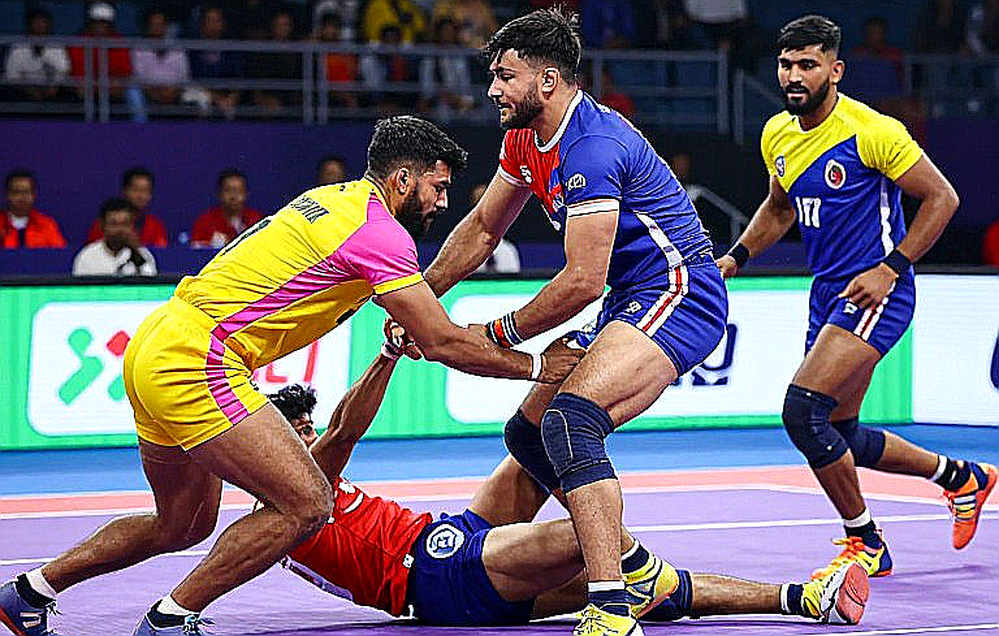
According to the report, the 13th season of the Pro Kabaddi League has been pushed to June-July 2027. The stated reason is that the league has no new media-rights deal — the previous broadcaster has gone and a new one has not been agreed.
To understand this single fact's significance, look at kabaddi's economic structure. Since the PKL began in 2026, the professional tier of Indian kabaddi has run entirely on one model: television broadcast → sponsorship and advertising revenue → franchise budgets → player salaries. The first link is indispensable. If there is no broadcast, there are no viewers to show sponsors, and if there are no sponsors, franchises have no money to spend.
This is not routine calendar adjustment. A full-year deferral, reflecting what is largely a deadlock in media-rights negotiations, brings several risks: a year-long gap in player income, instability in franchise management, distracted sponsors, and most importantly, a basic question for young players — 'if the biggest league isn't even happening, what does a career in kabaddi mean?'
A structural insight emerges here. The Kabaddi Champions League's expansion looks more logical not despite this crisis but because of it. When the national league stalls, thousands of trained players are left without a platform. In that situation, any regional league that can offer playing opportunities becomes immediately relevant. That is opportunism, and opportunism is not inherently wrong — but presenting it as 'the league's growing strength' is misleading.
Part Six: The Depth of the Player Market — Is a Pool of 300 Enough?
An auction pool of more than 300 players sounds impressive, but one question remains unanswered: how many of them are actually of PKL standard?
Reaching 300 out of 6,400 registrations is a hard filter — about 4.7 per cent. It shows the selection process is somewhat serious. But the rigour of the filter and the quality of what survives it are two different things. If the initial pool already had limited numbers of high-calibre players, a rigorous selection will not create quality.
One indicator lies in auction prices. When the top bid is Rs 17.4 lakh and 300 players are available, it means supply exceeds demand — buyers (franchises) are few, sellers (players) are many. That situation is unfavourable to players and reflects the league's bargaining power.
Another point is worth noting: the report names only five players, and even their roles (raider/defender/all-rounder) are not clear. There are no raid points, tackle points, success rates or match-impact figures for any player. This means the auction can only be evaluated on prices, and even relative to this league's own context, the prices are modest.
Part Seven: Governance and Sanctioning — the Biggest Unanswered Question
Here is the most serious gap in this entire report. It is not clear who owns the Kabaddi Champions League, who runs it, and most importantly, whether it has been sanctioned by the Amateur Kabaddi Federation of India (AKFI) or the International Kabaddi Federation (IKF).
This is not a technical detail. The question goes directly to players' careers. If a league is not sanctioned by a recognised federation, the national-team eligibility of players who participate in it can be called into question. That is particularly serious for players with international standing — such as Sunil Malik, if he really did captain India at the Asian Games.
The history of Indian sports administration reinforces this concern. The AKFI has passed through repeated disputes and administrative crises, and in such conditions several private leagues have operated outside formal federation approval. The consequences are a fragmented player market, no standard for contracts, and ambiguity in national-team selection.
Beyond this, three further things are entirely absent from the report. First, the nature of player contracts — whether they are multi-year, and whether they contain injury cover, insurance and payment guarantees. Second, anti-doping arrangements — control has historically been weak at rural and semi-professional events. Third, refereeing and rule standardisation — it is not even clear whether the league is played under Standard Style 7-vs-7 rules or Circle Style.
This last point is especially important. If the league is played in Circle Style (circular ground), it is an entirely different sporting product and comparing it with the PKL would be wrong in itself. If it is Standard Style, comparison is possible, but the foreign-player quota and squad size should then also be clear. The report contains none of this.
Part Eight: The Commercial Structure — Four Basic Questions, Four Empty Answers
Any league's commercial health is assessed on four pillars: broadcast rights, sponsorship, ticketing/attendance and revenue. This report does not mention one of them.
This is not an ordinary omission but reporting's largest gap. In a story about a league's expansion, it is essential to state where the expansion is financed from. If the number of teams is going from 8 to 10 and the budget is rising to Rs 5 crore per team, the natural question is: where is the money coming from?
There are three possibilities. First, franchise owners are putting it in as investment — common among early-stage Indian leagues. Second, a promoter is subsidising it centrally. Third, the league has a revenue stream that has not been disclosed. The third is the least likely, because if it existed it would have been mentioned in the reporting.
Another important analytical point: the report mentions no broadcast deal at all. This suggests the league currently has little or no television or digital media-rights value. If it did, that would be a central fact in the expansion story.
For this reason it is fair to say that the claims of expansion and budget growth are currently unsupported by any revenue-side evidence. This is a classic pattern of 'growth presented as progress' — where supply-side numbers (teams, trials, budgets) are shown rising while demand-side silence (viewers, revenue, broadcast) persists.
Part Nine: The Risk Picture
On the available information, the risks to this league can be assessed at three levels.
High-level risks: the PKL broadcast crisis. This is the biggest risk and it is not the Champions League's but the whole ecosystem's. If the PKL sits out a season, the professional tier loses its media exposure and sponsorship base, and no regional league can fill that void. A second high-level risk is the uncertainty over governance and sanctioning. In addition, the absence of broadcast and revenue data keeps the expansion claims uncertain.
Medium-level risks: the league appears national by name but is regional, which can misdirect the expectations of viewers and sponsors. Moreover, with salaries far below the PKL, retaining top talent over time will be difficult. If the PKL returns, the best players will go back.
Low-level risks: the 'Champions League' name may lead audiences to overestimate the league's status, and the ambiguity over Standard versus Circle Style makes technical comparison difficult.
The overall risk rating is high — but that high rating comes not from this small regional league's own risk profile but from the broader signal that has surfaced incidentally in this story. A league's expansion is being sold as positive news while the sport's main load-bearing pillar stands still.
Part Ten: What to Watch Next
There are five signals readers and analysts should track.
First, the PKL's new media-rights deal. This is the decisive signal. If a deal is struck and the 13th season is confirmed, the ecosystem's uncertainty will partly resolve. If the deferral lengthens or no broadcaster is found, the crisis will deepen.
Second, federation sanctioning for the Champions League. Any AKFI or IKF statement will clarify whether the league is a legitimate feeder tier or an unsanctioned event. This bears directly on players' eligibility.
Third, any broadcast deal for the league. If a television or digital rights agreement emerges, the expansion claim will get its first solid footing.
Fourth, verification of Sunil Malik's 'Asian Games captain' designation. This can be checked against official rosters. If the designation turns out to be old or from a different style, it will raise questions about the reporting's accuracy.
Fifth, attendance and revenue figures for the second season. If the league discloses ticket sales, attendance or revenue in any form, its commercial sustainability can be tested for the first time.
Conclusion
The summary is this: the 'expansion and bigger purse' headline is really the story of a small, Haryana-centric developmental league arriving at a time when the sport's main competition, the PKL, is in a broadcast-driven stall. The expansion is not proof of momentum but an opportunistic stopgap. And the report's central figures — a Rs 5 crore purse and a top bid of Rs 17.4 lakh — are too small and too thinly sourced to signal genuine commercial strength.
The biggest information gap in this story is that the most important element is not in the headline. The PKL has lost its media partner, the 13th season has slipped to 2027, and no new partner has been named. For a broadcast-dependent sport like kabaddi, that is not a minor date change but a potentially system-level commercial shock.
And the Kabaddi Champions League should be judged in exactly that context: it is a genuine opportunity, particularly for the thousands of young players in Haryana who would otherwise be left without a platform. But it is, for now, an opportunity, not a proven achievement. Four things are needed before it can be presented as an achievement: institutional sanctioning, disclosure of broadcast or revenue, transparency in player contracts, and performance data. Without them, this is a story of aspiration, not of progress.