
Kabaddi: From Mud Courts to Global Arenas, Pro Kabaddi League Changed the Sport's Image
कबड्डी दक्षिण एशिया का परंपरागत टीम खेल है जिसमें सात खिलाड़ियों की दो टीमें एक रेडर के माध्यम से अंक अर्जित करती हैं। 2014 में शुरू हुई प्रो कबड्डी लीग ने खेल को व्यावसायिक आधार और टेलीविजन दर्शक दिए। भारत अंतरराष्ट्रीय स्तर पर सबसे मजबूत टीम है, जबकि ईरान और दक्षिण कोरिया जैसे देशों का स्तर लगातार बढ़ रहा है।
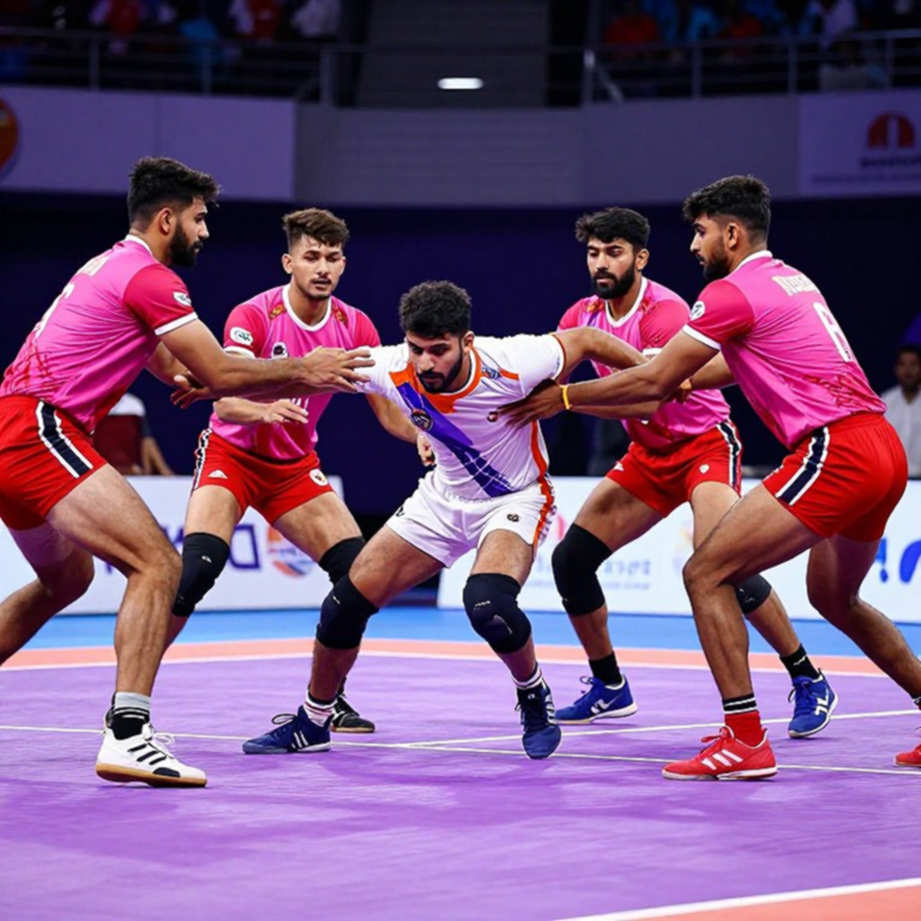
Kabaddi is a sport that carries neither the speed of hockey, nor the clamour of cricket, nor the global glamour of football. Yet from the mud courts of Indian villages to international arenas, the sport has carved out a distinct identity of its own. Two teams of seven players, a thirty-second raid, and that unmistakable tradition in which the raider chants kabaddi-kabaddi while crossing into the opponent's half — this is the essence of the game. It is a blend of physical strength, breath control and tactical awareness that few other team sports can match.
The rules look simple, but the moment play begins every second becomes complex. Seven players are on the mat at a time. The raider must enter the opponent's half, touch a defender and return safely to his own side within thirty seconds. A successful touch earns one point. If the raider is caught, the opposing team gets a point and the raider is out. If all players of a team are out, the opposition earns a lona, worth two points, and all dismissed players return to the mat. It is this rule that keeps matches alive until the final second.
Traditionally, the sport has been played across India under different names. The episode of Abhimanyu entering and being trapped in the chakravyuh in the Mahabharata is often compared to a kabaddi raid. For centuries the game has been part of village fairs, schools and local competitions. But for decades it was not treated as a serious professional sport. There was no organised league, no major broadcast rights and no financial security for players.
The picture changed most dramatically in 2026, when the Pro Kabaddi League was launched. Starting with eight franchise teams, the tournament brought the sport into television prime time. A franchise model, auctions, player bidding and packed stadiums gave kabaddi a new commercial structure. Players who once stopped at the district level suddenly had a major platform for their careers.
After the league arrived, the economics of the sport changed visibly. The number of teams grew, broadcast reach expanded and the number of local kabaddi academies increased in several states. Players became known nationally rather than remaining confined to their states. Stadium attendance and television ratings demonstrated that with the right format and presentation, the sport could hold viewers' attention.
The league produced stars who have become synonymous with kabaddi. Pardeep Narwal is called the Dubki King for his dubki and explosive raiding. Naveen Kumar is known for his consistency and speed. Raiders such as Ajay Thakur and Rohit Kumar strengthened the spine of the Indian team. In defence, players like Iran's Fazel Atrachali showed that kabaddi is no longer a sport confined to India. The participation of foreign players has given the league an international flavour.
Kabaddi has also expanded internationally. The sport has long been part of the Asian Games and India has remained its strongest contender. Countries such as Iran, Bangladesh, South Korea and Thailand have also built stronger teams. The Kabaddi World Cup hosted in India in 2026 placed the sport before a global audience. The rise of teams like Iran suggests that the contest will only get tougher in the coming years.
Women's kabaddi has built an identity of its own. Since women's kabaddi was included in the Asian Games, participation by women players has grown steadily. At the domestic level, women's leagues and tournaments are seen as important steps towards expanding the sport, although much potential remains untapped in this area.
Alongside all this, challenges remain. Shortages of grounds at the grassroots, limited sports education in schools and inadequate financial support for state-level competitions are persistent problems. A popular league is necessary, but its sheen can only last if the system for nurturing talent at the lower levels is strengthened. Maintaining audience interest will require a balance between novelty in format and genuine competitiveness.
Overall, kabaddi today stands at a point where it has both its tradition and the structure of a modern professional sport. The question is not whether the sport can be popular, but how that popularity can be taken down to the grassroots. If administrators, franchises and players work together in this direction, kabaddi will not remain merely a South Asian sport but can secure a strong place on the global sporting map.
संबंधित खिलाड़ी
लोकप्रिय/पसंदीदा पुस्तकें
Commonwealth Kabaddi Championship 2026: 13 Teams, 9 Days, and a Broadcaster Nobody Can Name2026-10-30
India vs England, Match 4 — The Ahmedabad Notebook: A Big Scoreline Will Tell Us Almost Nothing About This Team2026-10-29
India's Real Opponent in Ahmedabad Isn't England — It's a 62-Match Calendar2026-10-29
First Commonwealth Kabaddi title in Ahmedabad: India's first opponent is the calendar, not the mat2026-10-28
The Third Raid: Kabaddi's Comebacks Are Built by the Rulebook, Not Momentum2026-10-25
India vs Uganda, Commonwealth Kabaddi Championship 2026: The Missing Queue Matters More Than the Scoreboard2026-10-25
अनुशंसित
Inside the Lobby Line: How Review Didn't End Kabaddi's Arguments, It Moved Them Into the Referee's Room2026-10-28
Kabaddi's Second Half: The Tape, Iran, and the Economy the Scoreline Hides2026-10-26
The Architecture of Pressure: From Jakarta's 18-27 to Iran's Kabaddi Wall2026-10-25
Commonwealth Kabaddi 2026, Day 1: The 59-30 Scoreline Is True. The Table Is Not.2026-10-25
Commonwealth Kabaddi Championship 2026: Day 1 Table Built on Score Difference, and Bangladesh Third Without Playing a Match2026-10-25
Commonwealth Kabaddi Championship in Ahmedabad: For India, This Is a Bigger Test Than the Trophy2026-10-29
Commonwealth Kabaddi Championship: How the Day 1 Table Exposes the Incompleteness of 'International' Kabaddi2026-10-25
अनुशंसित
Behind the 46 Hides a 26: The Crack in India's Win That Iran Will Turn Into a Wall2026-10-25
Commonwealth Kabaddi Championship 2026, Day 1: The Scoresheet Adds Up, the Table Misleads2026-10-25
The Scoreboard Will Lie in Ahmedabad: India's Real Opponent Is Not England, It's Who Isn't on the Mat2026-10-29
46–26 Is a Diagnosis, Not a Victory: Two Blank Spaces in the Scorebook Before India vs Uganda2026-10-25
Kabaddi: From Mud Courts to Global Arenas, Pro Kabaddi League Changed the Sport's Image2026-11-01
Night One in Ahmedabad: What the Scoreboard Won't Tell You Before India vs England2026-10-25
Commonwealth Kabaddi Championship 2026: Day 1 Table Built on Score Difference, and Bangladesh Third Without Playing a Match2026-10-25
अनुशंसित
The Scoreboard Will Lie in Ahmedabad: India's Real Opponent Is Not England, It's Who Isn't on the Mat2026-10-29
India Won 46-26, but England's 26 Points Are the Real Story2026-10-25
The Ahmedabad Day-1 Table: A Team With Zero Raids Sits Fourth2026-10-25
Commonwealth Kabaddi Championship 2026: 13 Teams, 9 Days, and a Broadcaster Nobody Can Name2026-10-30
Day One in Ahmedabad: A Points Table Correct in Arithmetic, Nearly Empty in Kabaddi2026-10-25
India vs Uganda, Match 9: The Win Reads 46-26, the Worry Reads 262026-10-25
Behind the 46 Hides a 26: The Crack in India's Win That Iran Will Turn Into a Wall2026-10-25
अनुशंसित
Commonwealth Kabaddi 2026: The Real Question in India vs England Is Not the Scoreboard but the Rotation Sheet2026-10-30
Commonwealth Kabaddi Championship 2026: Day 1 Table Built on Score Difference, and Bangladesh Third Without Playing a Match2026-10-25
The Scoreboard Will Lie in Ahmedabad: India's Real Opponent Is Not England, It's Who Isn't on the Mat2026-10-29
Behind the 46 Hides a 26: The Crack in India's Win That Iran Will Turn Into a Wall2026-10-25
The Scoreline Said 38-29; the Tape Said Something Else: The Real Ledger of Kabaddi's Regular Season2026-11-01
Insufficient Input: Kabaddi News Report Cannot Be Generated2026-11-01
Kabaddi's Second Half: The Tape, Iran, and the Economy the Scoreline Hides2026-10-26